Blog Captain

My photo
Anchorage, Alaska, United States

Thursday, September 29, 2011

NPRBs Historic Arctic Meeting in Barrow

Dr Glenn Sheehan (Senior Scientist, Barrow Arctic Science Consortium, BASC) showing NPRB members around the excellent new science facilities at BASC (photo courtesy of Eric Olsen)

Last week, I participated in an historic meeting of the North Pacific Research Board in Barrow.  This was the first time that the Board has meet in a  rural location in Alaska and only the second time the Board had met outside Anchorage.  Barrow was an ideal location for the meeting as one of the key topics discussed during the meeting was the development of a new Arctic research initiative in partnership with Arctic industries, communities and other research organizations such as the National Science Foundation.

Dr Cynthia Suchman, NPRB Executive Director, welcoming community participants in an evening meeting with the NPRB
(photo courtesy of Eric Olsen)

In addition to the usual Board business, we were also able to engage with a  diverse group of stakeholders in Arctic research and education.  One of the most memorable presentations we received was from the North Slope Borough School District Superintendent, Peggy Cowan, who outlined the remarkable steps the District is taking to link science literacy with Inupiat culture.  While in Barrow, NPRB staff also presented a series of lessons to local students.

Board members inspecting coastal erosion at Point Barrow  - the rate of change in the Barrow coastline is accelerating (photo courtesy of Eric Olsen)

Overall, Board members greatly appreciated the opportunity to learn from Barrow residents and to assess first hand what is happening in the Arctic - it was pleasing to see how that meeting immediately informed Board decisions on Arctic research (see http://www.nprb.org/).  It will be fascinating to observe the impact of NPRB research on Arctic science and on resource use in the Arctic in the decades ahead.

Friday, September 16, 2011

Alaska SeaLife Center Accredited by AZA - We're In!

Once again I'm being a tad lazy by just reposting a press release that we issued today - couldn't share this news any better by rewriting... this was a TERRIFIC week for the Center and we are now very proud to be part of the AZA communty of practice...
With Brett Long and Lisa Hartman outside the AZA Accreditation Hearing in the CNN complex in Atlanta, GA - as you can tell, we were pretty happy with the outcome!!

Seward, AK – September 16, 2011 – The Alaska SeaLife Center (ASLC) this week was granted accreditation by AZA’s independent Accreditation Commission.  “By meeting the high accreditation standards of the Association of Zoos and Aquariums, the Alaska SeaLife Center has demonstrated its national leadership among zoos and aquariums,” said AZA President and CEO Jim Maddy. “Only the best of the best rise to this level, and we congratulate the professionals at ASLC for their hard work.”

To be accredited, the Alaska SeaLife Center underwent a thorough two year process to ensure it meets ever-rising standards, which include animal care, veterinary programs, conservation, education, and safety. AZA requires zoos and aquariums to successfully complete this rigorous accreditation process every five years in order to be members of the Association. Less than 5% of the nation’s 6,000 zoos and aquaria currently have this gold standard certification.

“The Alaska SeaLife Center is a great place for people to connect with the natural world and each other,” Maddy added. “Members of the Association of Zoos and Aquariums, including ASLC, support their communities with affordable family recreation and science-based education programs.”

The accreditation process includes a detailed application and a meticulous on-site inspection by a team of trained zoo and aquarium professionals. The inspecting team observes all aspects of the institution’s operation in areas such as animal care; keeper training; safety for visitors, staff, and animals; educational programs; conservation efforts; veterinary programs; financial stability; risk management; visitor services; and other areas. The inspection team prepares an extensive written report for AZA’s independent Accreditation Commission. Finally, top officials are interviewed at a formal Commission hearing, after which accreditation is granted, tabled, or denied.

Alaska SeaLife Center CEO, Dr. Ian Dutton was in Atlanta this week to attend the AZA accreditation hearing and is delighted that the Center has received this level of formal recognition. “AZA accreditation means three things to the Center. Firstly it helps us ensure that we are meeting industry benchmarks and so enables our government, industry and community partners to be sure that that we are capable of providing the best in animal care and public education. Secondly, it provides our staff and volunteers with access to the knowledge and training in this sector. Thirdly it opens up a whole new array of funding and partnership possibilities – many zoos and aquaria now look to the SeaLife Center as their primary Arctic marine life partner.” Dutton paid credit to ASLC staff and Board members who have worked so hard to ensure we meet AZA and maintain standards. “Like all nonprofits, our staff and volunteers are our greatest asset, and this accreditation is a wonderful recognition of their professionalism.”
About AZA

Founded in 1924, the Association of Zoos and Aquariums (AZA) is a nonprofit organization dedicated to the advancement of zoos and aquariums in the areas of conservation, education, science, and recreation. Look for the AZA logo whenever you visit a zoo or aquarium as your assurance that you are supporting an institution dedicated to providing excellent care for animals, a great experience for you, and a better future for all living things. AZA is a leader in global wildlife conservation, and your link to helping animals in their native habitats. For more information, please visit http://www.aza.org/.

Thursday, September 1, 2011

A Whale of a View!

Opening of the new whale mural opposite ASLC on August 26th

Just last week, artists Justine Pechuzal and Liza McElroy completed the magnificent new whale mural on once drab walls opposite the Alaska SeaLife Center... and as these photos attest, the instant improvement in visual amenity was stunning! 
Many thanks to these wonderfully talented artists for their hard work, to the City of Seward (particularly Assistant City Manager, Michelle Weston) for supporting the project, to the landowners who granted permission for the mural and to all those staff and visitors who have encouraged us to keep improving the Seward waterfront through this kind of community art!
One of my favorite images of Seward's newest resident whales -
many thanks to our photographer Chip Arnold

Wednesday, August 31, 2011

Lost and Muddy for a Great Cause!

The hauntingly beautiful Lost Lake alpine area

OK, so I'm the first to admit I'm no longer much of a runner.  But I am a glutton for good causes and always up for a challenge... and so this year when Karla and I  saw the Lost Lake run for Cystic Fibrosis advertized (http://www.lostlakerun.org/), and we saw that it was possible to join the event as walkers, it seemed only logical that we would enter a 16 mile race and pay for the privilege!  That was back in April and we had all summer to train for the event... plenty of time... we'll start next week...

We were ruminating about our lack of training as the bus conveyed us from the Bear Creek Fire Station to the starting line at Primrose campground at 0630 Saturday morning in a light drizzle... as we descended from the bus to join 175 other walkers, I had a sinking feeling that weather conditions would only get worse.  As it turned out, that was remarkably prescient...
Lost Lake is one of those legendary alpine walks that we had managed to avoid doing for too many years and so it as with a  mixture of anticipation and apprehension that we set off up the trail 2 hours ahead of the main pack of runners.
Enjoying a stroll across the alpine meadows of Lost Lake  - what race?
After a long gradual ascent, it was wonderful to be above it all, walking through the Lilliputian plant meadows around Lost Lake... this truly is one of the most serene and spectacular vistas in Alaska.  And it was (mostly) flat!

One of the great features of the Lost Lake Run is the regular reminder of why you are there - each half mile there is a poster reminding you of the personal challenges posed by Cystic Fibrosis and inspiring you to reflect on what you can do to help with research and treatment

Just as we passed the half way point (feeling great), two things changed.  The weather quickly deteriorated (i.e. gusting sleet) and there was an increasing onslaught of runners who has started 2 hours behind us, but who now seemed to be somehow "motor powered" as the gunned their way across the moors. How else can you explain people running uphill at 10mph+?  I did make a mental note that they did not stop to take any photographs...

Needless to say it was all downhill from there - old mud and new mud, getting off the trail to allow more and more of the 500+ runners to pass, and yet more rain... and yes, the lack of training was starting to become evident, with increasingly heavy legs...
But as we crossed the line back at Bear Creek to the encouragement of a great group of race supporters, it was uplifting to realize that we were now enmeshed in the fellowship of a unique event.  Now in its 20th year, the Lost Lake run has become an Alaskan tradition -- inspiring, rewarding and tanatalizing --and it soon dawned on us that we now have a full 12 months to train for next years race!

Friday, August 26, 2011

Center’s Distance Learning Program Wins National Education Award


ASLC acting Education Director and Distance Learning guru, Laurie Stuart-Morrow doing what she does so very well - sharing knowledge about Alaska's marine ecosystems with the world!

I don't normally post our press releases verbatim, but this one says it all!!  What a tremendous accomplishment by our Distance Learning team - this award again demonstrates the power and quality of the education programs delivered by ASLC staff - we are actively building new parrtnerships with industry and communities in Alaska and globally to share these great programs even further!
Please  contact the ASLC education team to learn more about these amazing programs - or go one better and buy one for a school near you - they are terrific value and highly ranked by our peers! 
For immediate release
Seward, AK – August 26, 2011 – The Alaska SeaLife Center has just received a 2010-2011 CILC National Pinnacle Award from the Center for Interactive Learning and Collaboration (CILC). The award is presented annually to organizations posting outstanding K-12 standards-based interactive videoconferencing education programs.
To qualify for the award the provider must receive a minimum 2.85 average score out of a possible 3 on their program evaluations from educators during the school year. The evaluation assesses seven areas: two related to the effectiveness of the presenter and five related to the educational content of the program.


This is the second time in four years that the Alaska SeaLife Center (ASLC) has received the CILC Pinnacle Award. ASLC Education Manager and leader of the distance learning unit, Laurie Stuart-Morrow said she was delighted to again receive this high level recognition. “Each year the Center provides more than 300 distance education programs to students throughout Alaska, across the lower 48 and increasingly around the world – this past year the Center has begun a major partnership with Australian schools. We are very pleased to be formally recognized by industry leaders for our high education standards and to be able to promote improved understanding of Alaska’s marine ecosystems to such a vast and engaging audience”.


About CILC
The Center for Interactive Learning and Collaboration (CILC), established in 1994, is a not-for-profit specializing in access to applications and the utilization of videoconferencing for live interactive content and professional development, as well as web-based collaborative learning environments for K-12.


About ASLC
The Alaska SeaLife Center is a private non-profit research institution and visitor attraction which generates and shares scientific knowledge to promote understanding and stewardship of Alaska’s marine ecosystems. For more information regarding the Distance Learning program or other ASLC information please reference the Alaska SeaLife Center website at www.alaskasealife.org.

Tuesday, August 16, 2011

Fish On - another wonderful ASLC Invitational

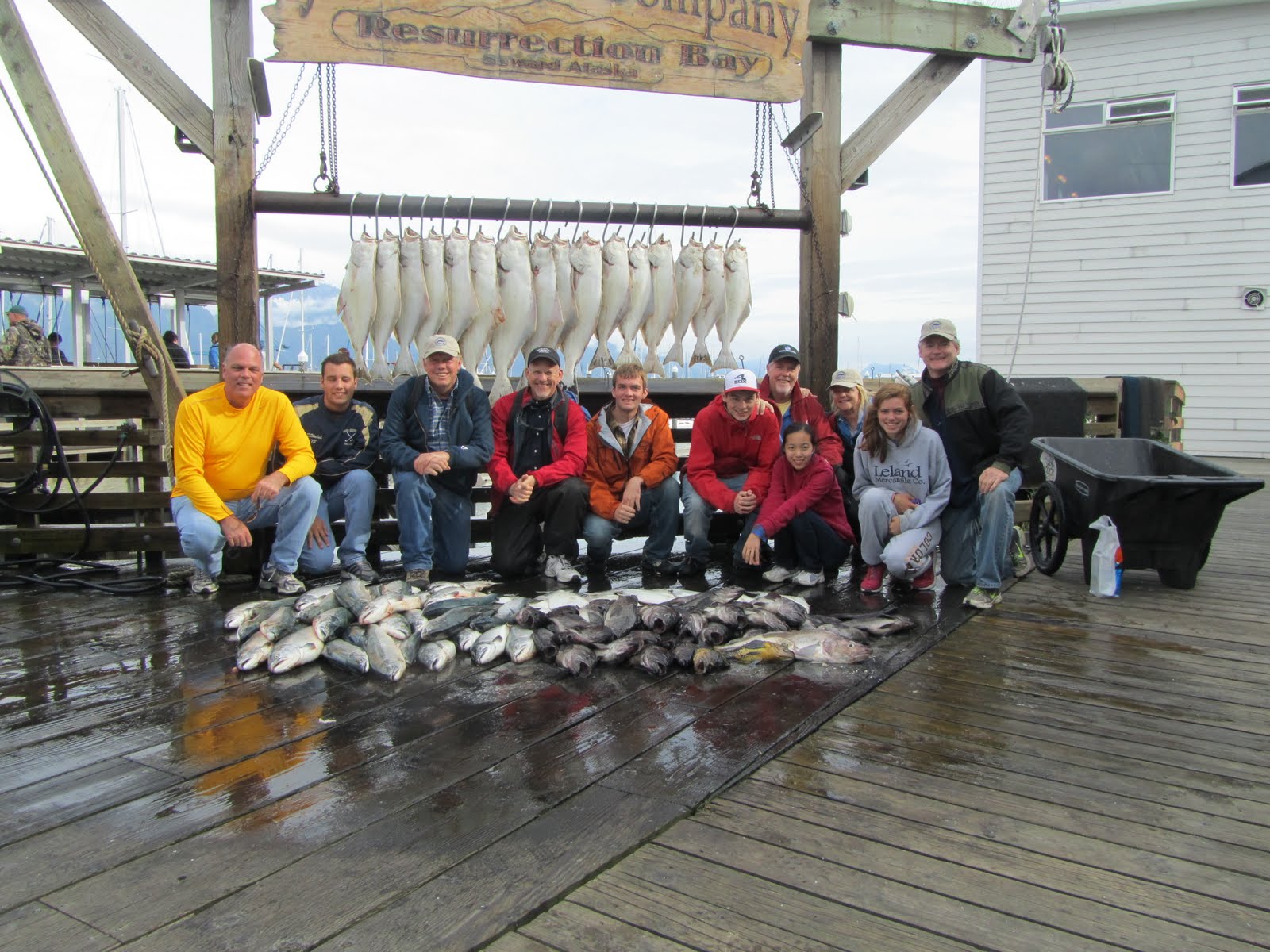
Our catch after an action-filled day of fishing out of Seward on the F/V Huntress

The 12th Alaska SeaLife Center Invitational lived up to all expectations, with a sensational day of fishing and a throroughly entertaining and enjoyable evening banquet.  While it is always fun to go fishing with friends, this years event was notable for three reasons.  Firstly, our patron, Alaska's Lt Governor Mead Treadwell, bought his family to Seward and as the photo above attests, they all share his great fishing talent!  It was great to out on a boat with the Lt Governor, and to see the next generation of Alaskans appreciate first hand the amazing richness and diversity of marine life that Seward has to offer.  Our organizational vision is for future generations of Alaskans to continue to enjoy the bounty of Alaska's oceans - there is no better way to invest them in that vision that to engage the next generation in understanding what we have and what it takes to sustain that fishery.
ASLC Board member Jason Brune demonstrating the strong competition between tables that was a fun feature of the SeaLife Trivia game!

Secondly, we had a very enthusiastic group of sponsors and supporters this year who really went the extra yard to make the event fun.  One example of that was the SeaLife trivia game during the banquet that was designed and led in their inimitable manner by ASLC Educators Darin Trobaugh and Laurie Morrow.  The game provided a unique opportunity to feature ASLC distance education programs that we now deliver more than 300 times each year globally!  The general level of knowledge of our oceans among guests was impressive and ultimately the winning table made a "well educated" guess to secure the prize!
Banquet guests enjoying the opportunity to catch up and share some wonderful desserts courtesy of our multi-talented staff and volunteer chefs!

Thanks again to all of our sponsors, guests, staff and volunteers who helped make this such a wonderful event.  We raised nearly $20,000 for the Center's research and education programs and equally importantly strengthened many longstanding friendships!...
Oh, and in case you didn't get the chance to go fishing with us, make sure you get out there during the Seward Silver Salmon Derby - there is a very strong run of silvers this year!
A beaming Mrs Dutton showing off her first silver of the day!

Thursday, August 11, 2011

Time for Greater Attention to Alaska's Islands??

Much of my career has involved working on islands systems.  From my early work on islands and cays of the Great Barrier Reef to my later research in Japan, various Pacific islands and Indonesia, islands have long held a special fascination for me.  That may be due to their unique characateristsics (e.g. many islands such as Sulawesi have high levels of endemicity).  It may be due to their often convenient scale - you can usually observe ecological and social processes more easily at island scale, particularly in isolated islands.  It may also be due to their pressing management needs - for example, islands are particularly vulnerable to change as a result of introduced species - Guam and other islands affected by introduced wildlife are poster childs for those types of impacts.  Those effects are not just confined to ecological impacts - consider, for example, the catastrophic losses and ongoing social disruption caused by the introduction of diseases to many Pacific islands by early explorers.
Maybe my fascination with islands is simply because they are typically beautful and unique places to work!  There are often a few perks involved in being one of the first researchers able to access remote islands and survey their ecology or cultures!  There are also a few down sides - in the mid 90s, I was part of a small team to undertake the first comprehensive survey  of the reefs around the Karimunjawa islands (just off the coast of central Java in Indonesia) - about 6 hours into our overnight small boat trip out there, the crew lost the boat propeller in about 40 feet of muddy water... fortunately they found it after just a  few hours of diving...

Photo of one of the Karimunjawa Islands courtesy of Central Java Tourism Office - more details available from

Even in the face of those types of tribulations, islands have proven to be rich natural laboratories - consider their influence on the work of Darwin, Wallace and other bio-geographers from the 19th century...

We have learned so much from islands and yet there is still so much to learn.
 

With increasing globalization, islands have come under severe pressure - there are many islands in the world where resources and cultures have been destroyed or severely degraded as a consequence of unsustainable exploitation of their resources.  Jared Diamond's book "Collapse" contains numerous examples of catastrophic change when resources and society are not 'in balance' - his work suggests that islands provide great insights into the the indivisibility of cultural and ecological sustainability.  Marcus Stepehen, the president of Nauru (an 8 square mile island in the Pacific) recently published an equally eloquent tale about what has happened to his country as a result of that lack of balance - http://www.nytimes.com/2011/07/19/opinion/19stephen.html.

There are several global efforts underway to promote a greater understanding of islands and the challenges they face as well as to promote a more sustainable approach to island development. Notable among those is the Global Islands Partnership (GLISPA) that was launched in 2006.  GLISPA seeks to conserve and sustainably utilize the invaluable island natural resources that support people, cultures, and livelihoods in their island homes around the world. It brings together island nations and nations with islands — small and large, developing and developed — to mobilize leadership, increase resources and share skills, knowledge, technologies and innovations in a cost-effective and sustainable way that will catalyze action for conservation and sustainable livelihoods on islands. (see http://www.cbd.int/island/glispa.shtml).

Analysis of Mexico's islands in the Gulf of California - details available at

Among the many exciting GLISPA initiatives underway globally, I was particularly impressed with a recent publication on the islands of Mexico.  The book (in spanish only) is beautifully produced and systematically evaluates threats to islands as well as priorities for action.  It is the sort of book that decision makers can easily understand...

I began searching for a comparable book about Alaska's islands.  Sure there are a lot of books and reports about various islands and island groups within Alaska, but nothing that systematically addresses the status and needs of our islands - that is pretty surprising given that Alaska is the most island rich state in the USA.  Alaska has 38 islands larger than 100 square miles (see http://www.worldislandinfo.com/US/AK/AKlargest.htm for the list - it would make a great local geography quiz question!). 

As far as I can tell, there is no complete inventory of Alaska's islands and no "big picture" assessment of their status, threats or management needs. 

A book like the Mexican islands report could play a valuable role in promoting awareness of Alaska's islands and would draw attention to the many key "known unknowns" that researchers and others might begin to focus on.  Anyone interested in working on this?