Blog Captain

My photo
Anchorage, Alaska, United States

Wednesday, May 12, 2010

2010 Global Biodiversity Outlook - 3rd report released

As I noted a few months ago 2010 is the International Year of Biodiversity.  More than 170 countries have invested much of the past eight years in a global plan of action to conserve biodiversity and 2010 was the target year for the culmination of many of those efforts.


So how are we doing?

The third Global Biodiversity Outlook (GBO) report was released earlier this week in Nairobi and it gives both a good account of what the world community has accomplished and the status of different biodiversity features - see .http://gbo3.cbd.int/home.aspx.   The GBO is  like a super school report card.  While it does not gives grades, it does give a good quantitative and qualitative overview of the performance of the biosphere of our planet.  The report should worry all parents as there is a consistent trend of decline and loss with very few highlights.  Below, I have extracted a few of the assessments presented in the report that relate specifically to marine and coastal systems:
  • 42% of all amphibian species and 40% of bird species are declining in population.
  • Fish stocks assessed since 1977 have experienced an 11% decline in total biomass globally, with considerable regional variation. The average maximum size of fish caught declined by 22% since 1959 globally for all assessed communities. There is also an increasing trend of stock collapses over time, with 14% of assessed stocks collapsed in 2007.
  • Protection of marine and coastal areas still lags far behind the terrestrial protected area network, although it is growing rapidly. Marine Protected Areas (MPAs) cover approximately half of one per cent of the total ocean area, and 5.9 per cent of territorial seas (to 12 nautical miles offshore). The open ocean is virtually unrepresented in the protected area network reflecting the difficulty of establishing MPAs on the high seas outside exclusive economic zones. Of 232 marine ecoregions, only 18% meet the target for protected area coverage of at least 10%, while half have less than 1% protection.
Most sections of the GBO provide a great visualization of the scale and severity of human impacts on biodiversity - a good example is the increasing area of marine dead zones caused by increased nutrient run off as depicted below.

There is little in the report that is specific to Alaska or even arctic systems, but that should not limit your review  as we know how closely linked all global life support systems are.  As UN Secretary General, Ban Ki-moon notes in his introduction to the GBO... "The consequences of this collective failure, if it is not quickly corrected, will be severe for us all. Biodiversity underpins the functioning of the ecosystems on which we depend for food and fresh water, health and recreation, and protection from natural disasters. Its loss also affects us culturally and spiritually." 
The report suggests that, in the absence of more concerted effort, we are approaching a global biodiversity tipping point as the figure below indicates.

The GBO is a timely reminder of the global importance of the science and education work undertaken here at the Alaska SeaLife Center - our work informs and enables improved stewardship of marine resources and has reach far beyond Alaska.

Tuesday, May 11, 2010

Arctic Coast and Bering Sea Overflight

The North Pacific Research Board has been implementing an integrated six year ecosystem research program in the Bering Sea region for several years now (see http://bsierp.nprb.org/).  The Board also funds research projects annually in other areas of Alaska and is moving forward with plans for both an integrated research program in the Gulf of Alaska (in final stages of approval) and in the Arctic.  As part of the design process for the Arctic program, Board members recently joined the regular Coastguard C-130 overflight over the north and west coasts of Alaska.

Inflight briefing on flight path and observation points

Passing by Denali, Foraker and other peaks of the Alaska range

Packed coastal ice in the vicinity of Barrow

Wainright settlement
Red Dog Mine infrastructure (near Kivalina)

Lower Yukon River and tributaries

Point Mackenzie, Cook Inlet and Anchorage
The overflight again reminded the Board of the vast scale of Alaska's coasts and the general lack of understanding of marine ecosystems and processes in much of the Bering, Chukchi and Beaufort Seas.  Presentations to the Board by NOAA and UAF scientists earlier in the meeting had emphasized how fast Arctic systems are changing and why there is a compelling need to document existing conditions and better understand ecosystem dyamics.  Information gathered during the flight will be very helpful in framing the NPRB Arctic strategy. 
Thanks again to the Coastguard crew who provided the observation platform and to the Board members for making time to join the flight... now if I can just get my hearing back...

Thank you Denis Wiesenburg (UAF)

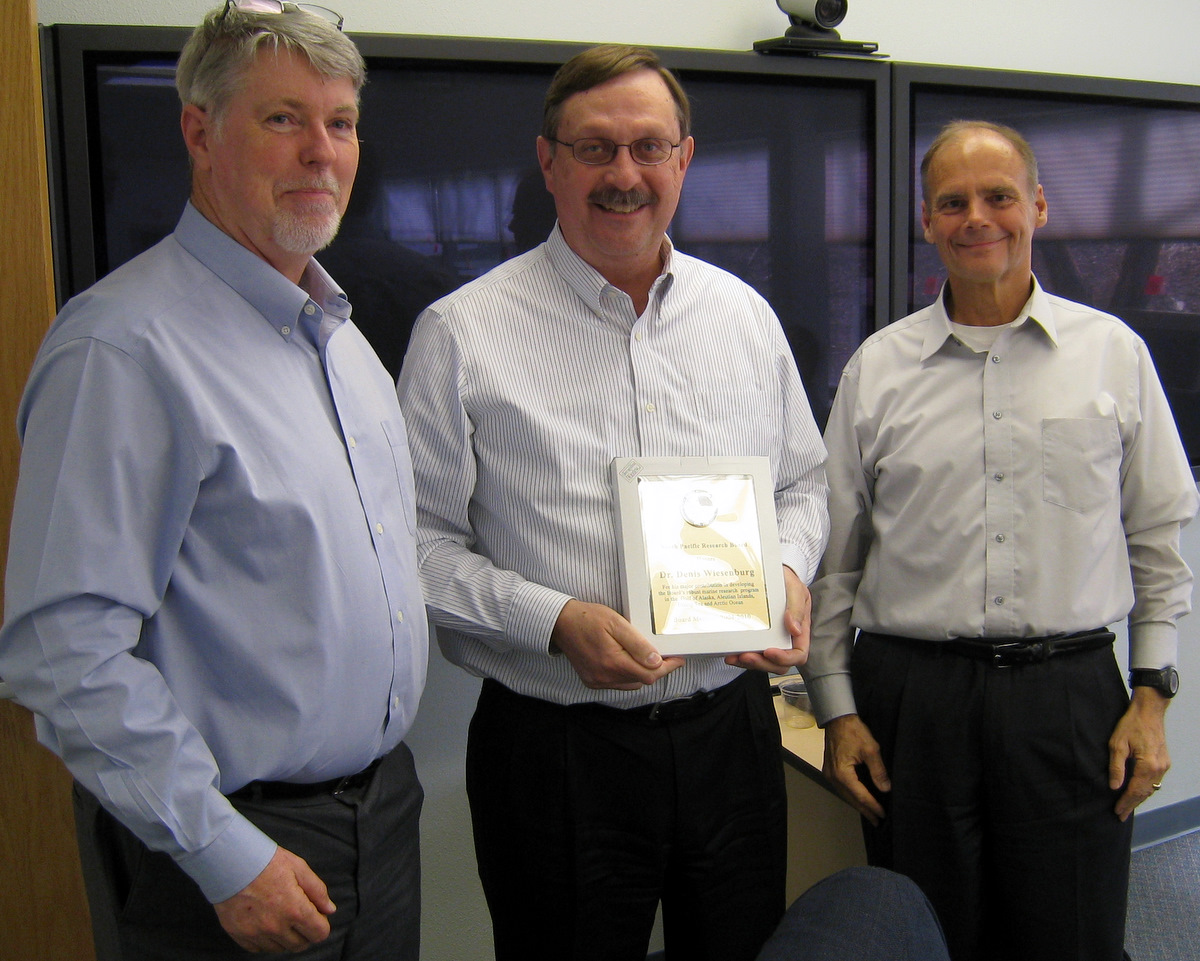
Dr Denis Wiesenburg (center) with Drs Ian Dutton and Clarence Pautzke at a recent NPRB meeting.

The Alaska SeaLife Center and the Alaskan marine science community is losing one of our truly visionary leaders.  Dr Denis Wiesenburg, Dean of the School of Fisheries and Ocean Sciences at the University of Alaska Fairbanks recently announced that he is resigning to take up a new appointment as the Vice President for Research at the University of Southern Mississippi.  Denis leaves us in June.
Denis has been a remarkably productive and energetic leader.  Over the past six years he has overseen a rapid growth in both undergraduate and graduate student numbers enrolled in fisheries and ocean sciences programs at UAF.  He also co-led the successful proposal to secure funding for the new arctic research vessel Sikuliaq and the building of the new Lena point SFOS campus of UAF in Juneau.

I had the privilege of serving with Denis on numerous boards and committees and he truly was a consistent advocate for building marine science capacity here in Alaska at all levels.  He pursued school level education through the Alaska Tsunami Ocean Sciences Bowl competitions with the same passion as funding for new advanced research technologies; he pursued recruitment of social scientists with the same vigor as he sought oceanographers.  In the often siloed world of university education it is rare to find such an "all round" approach to the ocean sciences.

His work with the SeaLife Center exemplified his commitment to quality research and education outcomes for Alaska.  He was both a strong advocate for the UAF staff at ASLC and a strong advocate for the ASLC in the broader Alaskan and national science communities -- he understood and valued the power of our partnership.
I will be eternally grateful for Denis's support during my first year at the SeaLife Center, and inspired by his vision for marine science in the North Pacific - he leaves a tremendous legacy at UAF. 
We wish Denis and his family all the very best in their new lives in Mississippi... true to form he has already jumped in to the Gulf oil spill response and so I suspect we'll be swapping notes for many years to come!

Friday, April 30, 2010

What Constitutes "Meaningful Public Education"?

On April 27th, the U.S. House of Representatives Committee on Natural Resources, Subcommittee on Insular Affairs, Oceans and Wildlife Committee conducted an oversight hearing into "Marine Mammals in Captivity: What Constitutes Meaningful Public Education?".
This topic has become topical in recent years due to efforts by some organizations to downplay the longstanding role that zoos, aquariums and other research and public display centers play in promoting public understanding of ocean life. The debate came into even sharper focus with the recent publication of an article in Society & Animals 18 (2010) 126-138 (see http://www.animalsandsociety.org/resources/index.php?pid=87&tpid=22). That article was critical of one of the benchmark studies to evaluate the impact of aquaria on visitor education (that report is available from http://www.aza.org/visitor-and-public-research/).

As ranking committee member, Congressman Don Young from Alaska noted in his remarks during the hearing, aquariums do indeed play a significant role in shaping understanding of marine life, particularly give the increasingly urban nature of modern society. As a former educator, he noted that his measure of success was that… “If I can encourage one young mind to begin to think, then I have accomplished my goal”. He went on to note that visiting aquaria generates an increased curiosity for marine species and that can play an influential role in education. Congressman Young’s full remarks can be viewed on http://donyoung.house.gov/.
I have no doubt that we meet that standard each and every day. The feedback we receive from our visitors (of all ages and backgrounds) routinely suggests that we do indeed provide them with an understanding of life in the oceans which is unique and valued and which motivates them to value our oceans more.
However, we also understand the importance of demonstrating the value to society of the privilege we are afforded in being able to maintain animals for display and for research and so I tracked this week’s hearing with great interest. The full testimony presented by eight panelists is available from the Committee website: http://resourcescommittee.house.gov/index.php?option=com_jcalpro&Itemid=60&extmode=view&extid=348.
The comments by new National Marine Fisheries Service Assistant Administrator, Eric Schwaab, were particularly insightful. He noted that… “NMFS acknowledges that there are many different ways to educate the public about marine mammal conservation. Approximately 100 facilities hold marine mammals for public display purposes and each facility has tailored its education and conservation programs to serve particular audiences within the constraints of available resources. To create a “one size fits all” approach to educating the public fails to embrace the need to craft current and meaningful messages utilizing the many different educational resources available”.

Clearly there are a range of perspectives on how best to educate the public about ocean life and that divergence of viewpoints reinforces our commitment to exceed all regulatory standards and industry best practices and to ensure that there is a clear line of sight between our research, education and stewardship activities.

I hope that our visitors will continue to be patient with our staff as we again survey visitors in 2010 to better understand how we affect people’s knowledge, behavior and attitudes…. and please – don’t be backward in letting us know what your visit to the Center meant to you!

Monday, April 26, 2010

UAF SFOS Advisory Council Meeting - Fairbanks 17-18 April

2010 SFOS Advisory Council members (left to right): Jim Balsiger, Margaret Williams, Jay Stinson, Ian Dutton, David Policansky (chair), Heather McCarty (vice-chair), Bruce Bustamante, Arliss Sturgulewski, Jim McCarthy, Cynthia Jones, Knut Aagaard and Eric Olson.  (photo courtesy : Carin Stephens, UAF-SFOS)

I recently had the privilege to join a distinguished group of colleagues at the Annual meeting of the UAF School of Fisheries and Ocean Sciences (SFOS) Advisory Council which was held in Fairbanks.  The SFOS Advisory Council brings together a diverse group of stakeholders in marine science, education and management and provides advice to the Dean and faculty as well as an annual report to the Chancellor of UAF.
This year's meeting provided a chance to reflect on the many accomplishments of the School over the past year, including:
  • approval of final funding of the new Arctic R/V Sikuliaq - now being built at the Marinette shipyard in Wisconsin
  • receipt of >$25 million in new research awards which is around 20% of all UAF research awards
  • hosting of the 12th annual Tsunami Bowl competition in Seward with 16 teams participating
  • a dramatic increase (116%) increase in undergraduate fisheries student enrolments
  • addition of six new Faculty in 2009
Additional recent accomplishments are described on the SFOS website (http://www.sfos.uaf.edu/) - clearly this is a vibrant and progressive program with a tremendous future given the rapidly expanding and ever changing needs for improved marine science in Alaska.

The Council was saddened to learn of the impending (mid 2010) resignation of SFOS Dean, Denis Wiesenburg.  Denis is returning to his home State to become the University of Southern Mississippi's Vice President for Research.  Denis also serves on the ASLC Board and many other committees that I work with and so his departure represents a major loss to many institutions beyond UAF.  I was pleased to be able to join Denis and his wife Jean together with many SFOS faculty at a wonderful send-off dinner during which we all had the chance to acknowledge his amazing accomplishments over the past six years... and chasten him for leaving at such a critical juncture in SFOS's evolution!

The Council wrapped up our meeting by providing a range of inputs to the UAF Chancellor on key issues facing the school - an obvious priority  is to find a new Dean quickly so as to sustain the momentum that Denis and other senior Faculty have built. 

We look forward to working with whoever moves into that key role.


Earth Day 2010: 4 for 40

Earth Day 4 for 40 Poster and Coastal America Staff at Congressional Casting Day
(photo courtesy Virginia Tippie, Director Coastal America)


Hard to believe that this year marked the 40th Earth Day!  One of the activities we undertook was to share the beautiful Earth Day poster developed by the Coastal America Partnership (http://www.coastalamerica.gov/).  The "4 for 40" Poster promotes a  "rivers to the sea" watershed theme. The poster was developed by the Coastal America Southeast Team, EPA, CWRP and CH2MHill. It encourages folks to get involved and commit to 4 things for the 40th Anniversary of Earth Day.


The poster also directs folks to the Coastal America website which has 3 Earth Day related links:
1. The "4 for 40 poster" link includes Earth Day related activities, a pledge site, an interactive testimonials site and a kids hemisphere site.
2. The "Learning Center Network" link directs people to our network of aquariums and science centers (of which the Alaska SeaLife Center is a member) to learn more about Planet Ocean and how to get involved in learning center activities.
3. The "Oceans" link connects folks to clips from the new Disney Oceans Documentary that was released for Earth Day, educational materials and ocean information sources such as NOAA and other science organizations.
We'll continue to use the poster and related Coastal America materials on watershed-marine links going forward - stay tuned to the Oceans Today Kiosk that we expect to open in  late May. 

Friday, April 16, 2010

ASLC joins AMMPA

I was delighted to join Brett Long (ASLC Director of Husbandry) this week to attend the Annual Meeting of the Alliance of Marine Mammal Parks and Aquariums (AMMPA) held in Alexandria, VA. 

AMMPA is an international association representing more than 60 marine life parks, aquariums, zoos, research facilities, and professional organizations dedicated to the highest standards of care for marine mammals and to their conservation in the wild through public education, scientific study, and wildlife presentations - see http://www.ammpa.org/ for full details of the membership and work of AMMPA.

At the meeting, we made a presentation to secure membership of AMMPA and we were one of four new members provisionally accepted at the 2010 meeting.  Members were particularly impressed by our strong research and education programs as well as our high standards of animal care.

The next step in the process is for the Center to be visited by a  team of AMMPA inspectors who will undertake a thorough review of our facilities, systems, practices and staff capacity to ensure we meet their demanding standards - we must complete that process before the next AMMPA Annual Meeting in April 2011. 

This is a key step in our long-term commitment to continually meet global best practice standards in all areas of center operations - our standards are already high, but through the AMMPA network we have the opportunity to more actively engage with our many peers in the aquarium industry and to contribute our unique skills and experience.  At the meeting, Brett and I held numerous sidebar meetings with many of the 90+ industry leaders in attendance who work on Alaska marine mammals and it was clear there is much interest in working more closely with us!

Please let Brett or myself know if you'd like to know more about AMMPA or our overall accreditation processes.